
Posts RSS Comments RSS 98 Posts and 44 Comments till now

Jimeni: CCNA Passed, Now Job?

# 01 Jimeni

I passed my CCNA in May, I’ve been in Tech support for seven years now but I’ve been working for myself for the last four years. I spent three months studying for the exam and now hope to move into networking in an organisation.

I’m really enthusiastic about learning new things and getting going down this new path but it seems getting a job is easier said than done.

I’ve applied for plenty but I think being self employed may be putting people off. Does anyone have any ideas on how to get my foot in the door? I’m thinking of writing letters to some companies to ask for work experience, it obviously means more time with no wages but it might get me the experience required. Any ideas on the types of companies? Just any large company with a Network?

# 02 Rickey

I’d keep hunting.  I know one thing that helped me is I sought out everyone I knew of to try to get something started.  I used all the online tools to help find employers seeking employees in my area.  I would definitely seek out people to volunteer.  That would definitely boost your rep to another company when they see you volunteered to learn the stuff.  I ended up just getting a normal IT job, but in the interview process I showed that I had excellent networking skills so from the get go I was thrown projects with networking every now and then.  It always helps to wear multiple hats.

# 03 Scottyyyc

I was in a similar position several years ago. I just treated my own company as any other company as far as listing experience on my resume. There shouldn’t really be much about it that turn people off otherwise.

Keep in mind, despite everyone’s best intentions, the whole global economy thing is a big issue right now. The fact of the matter is that just about everything has slowed down a bit, and most company’s are being very cautious hiring. I’m in a pretty strong economy in Western Canada, and things are still a little slow. I’ve noticed about 1/2 to 1/3 as many job postings as compared to a year or two ago.

Just keep plugging at er. Remember, try to differentiate yourself on your resume. Don’t just list the kinds of things you ‘did’, mention all of the innovations you brought to the table, and the things that changed as a result of your individual efforts. You really have to go that extra mile in selling yourself. Simply mentioning you installed this, and setup that, isn’t enough right now.

# 04 dmolfetas

Some good advice was posted already. Have you visited any job fairs in your area ? Is the available time being used for pursuing an additional certification ?

Also, consider creating a profile on an online networking site if you don’t already have one.

I, too, am also available for immediate hire which gives me an excellent opportunity to continue studies in R&S through the CCNP.

# 05 Jimeni

Thanks for the good advice everyone, its good to hear other people have been in the same shoes. I’m using my time to study for my MCSA and ITIL foundation. Its not being wasted but I’ll be sure to get on and try to do some volunteer work, would an ISP be a good start? I’ve seen a few offering networking jobs requiring experience and I’ve started asking them if they have any more junior positions or if I could do some work experience.

I’ll keep and it and try to keep my chin up, I just really want to ‘Dive in’ and get working ASAP. I’m certain if I got an interview my passion and work ethic would get someone interested I’m just struggling to get to that stage.

I’ve just joined linked in so I’ll see how that goes. I feel like going for a CCNP without networking experience may not be the best idea so thats why I’m trying to get my Microsoft Cert and then hopefully move back to Cisco if I can land a networking job in between.

Thanks so much for the advice any more would be much appreciated!

Needing Help, General Question Of CCNA

# 01 ldgotz

I am presently studing to my ccna exame..

One of the videos that I watched was and example of setting up a trunk link

the discussion talked the definition of a trunk being..

 A link that passes all vlan trafic …
then they continued with the tutorial of setting up this trunk link..
and it ended with them assigning a Vlan to the trunk link…

If the trunk passes all vlans.. why would you assign a vlan to it? after a day of searching the web, with no real luck for an answer

other then   ==> best practice..
I came here to ask the question….

Is there a real reason to assign a vlan to a trunk link?

# 02 Chris Buscemi

Because it is a trunk link and is designed to pass all VLAN traffic to the next switch you don’t (actually I believe you can’t) assign that port to a VLAN. The only time you assign any VLAN configuration on a trunk link (aside from manual pruning) is when configuring router-on-a-stick. And the VLAN configuration goes on the router side of the trunk under the subinterface, not on the switch port.

# 03 Conwyn

Normally trunks carry all the vlans  but in voice network you often have two trunks one carry vlan traffic for data and the other carrying the voice vlan traffic. You can also prune so you do not send data for vlan x down a trunk when you know there are no vlan x ports beyond the trunk.

# 04 ldgotz

I understand this concept…
BUT why would you assign a vlan to a trunk…..
yes it can be done.. i did it on the lab equipment,
and in the simulator program….

I Just do not understand the reason for doing it..  if there is a reason.

# 05 Chris Buscemi

From what I’ve seen on my lab equipment, you’re right, you can assign a VLAN to a trunk port. However, as long as the port is in Trunking mode, the VLAN assignment is listed as “inactive” under the show interface (int#) switchport output. Once you code the interface to be in access mode, the access VLAN comes up.

I don’t know of any circumstance where you would even bother assigning the trunk port to an VLAN, given what the trunks are designed to do. Perhaps one of the resident experts here know of some reason why you would. However it is best practice to know what interfaces on your switches are trunks, and to therefore hard code them to be trunks, thereby disabling the VLAN assignment you’ve given them.

Now, in reference to Conwyn’s comments, I can definitely see why you would want a seperate trunk for your VoIP traffic, but that would actually be a seperate physical trunk link on the switch that you only allow the Voice traffic on. And while you can control which VLANs are allowed on the trunk, that is not the same as assigning the trunk port to a VLAN.

So in short, I too don’t see the reason why you would bother, and more over why they would have shown you the process to do that.

# 06 Matt Kerry

Hello ldgotz, Can you post the config that was demonstrated in the video you watched?

# 07  Conwyn

Sorry I mis-understood. You assign a vlan to trunk port because if the other end is not defined as a trunk then this end becomes an access port in that vlan.

# 08 Travis Newshott

Conwyn is correct, assuming the port is configured with DTP to allow it to negotiate the state.  If you hardcode a port to be trunk and disable DTP, the purpose of assigning a VLAN is generally through the native vlan command to tell the trunk which VLAN should be untagged.  This allows you to specify the untagged VLAN to comply with network design standards, security procedures, etc.

When DTP is configured for negotiation, Conwyn is absolutely correct – you set a VLAN to ensure if it falls back to access mode, the correct VLAN will be utilized.

How Does Vouchers And Promotions Work?

# 01 alvand555

Where can we get them? How reliable are websites who claim to have vouchers? How often promotions happen and how inexpensive can we take an exam?

# 02 John

I don’t know the full details on this but i believe it is some sort of promotion for 2009 on certain exams.

I used a voucher after i failed my CCNA Wireless exam, I was entitled to a voucher/free go at a retest.

I am not sure if you can believe these websites, they are probably advertising something which you can get anyway like i did from a normal testing centre.

# 03 ciscoskeemz

I have a question in regards to this.

Does the comeback2009 count towards CCNA recertification. I’ve heard that, if you’re certification has expired, you can use this promotion to get certified again. Not sure if it’s true or not. Maybe a moderator can give some insight.

# 04 Rickey

The comback2009 does work for the CCNA concentration exams.  I definitely recommend using it if you fail a test.

# 05 ErickBCCNA

I am 99% sure the COMEBACK2009 promotion is for individuals that had existing CCNA certification and let them expire. hence the promo. name? 

That promotion is what inspired me to retake the exam.  I did not need to use the promotion, as I passed the first time through, but I was prepared to use it had I not passed.

It can also be used for concentration exams.

# 06 Andrew

Cisco offers promotions from time to time that target different audiences and have differing rules and time limits. Eligible participants receive an email invitation to participate.

How To Go About Getting Networking Job After CCNA

# 01 Miizarebel

What is the best way to go about getting a job after passing the CCNA exam? Would it make sense to continue on the CCNP track, using real equipment and wait until the opportunity comes along?

In these tough times when the market is so rough, i feel like i am falling behind in gaining a position. I currently do helpdesk/Jr. Administrator <– fancy title…  6 years desktop support experience looking to move over to networking….

I am currently studying for the BSCI exam…

# 02 Rickey

I would continue looking for a job.  Search for things like network technician, network engineer, network administrator.  Simple titles like that.  If you have a JR. Admin title and can explain the server/network experience you have then I would imagine that would increase your chances.  Make sure to highlight your certifications and career goals and desire to progress forward with the certification process.  I don’t know if you have any college education, but make sure that is highlighted as well.  That can make a big difference a lot of times.

# 03 ErickBCCNA

Congrats on getting the CCNA!

I am not sure if you have any experience in the networking industry.  Unless you have some conections with the powers that be, you are going to have to start small.  99.99% of employers aren’t going to just let you touch a Cisco router, switch, AP, ASA etc, until you can demonstrate to them that you have sufficient, “demonstrated” knowledge of the basics in the field first.  This may even begin with basic break/fix issues.  You are going to have to sweep up behind the elephant before you can run the circus so to speak.

Look for anything that will get your foot in the door even if it is break/fix things and continue to work on your CCNP track or next level certification.

31 Days Before Your CCNA Exam (2nd Edition)

31 Days Before your CCNA Exam, Second Edition, offers you a personable and practical way to understand the certification process, commit to taking the exam, and finish your preparation using a variety of Foundational and Supplemental study resources.

The book breaks down key exam topics into 31 daily review sessions using short summaries, lists, tables, examples, and graphics. A Study Resources section provides you with a quick reference for locating more in-depth treatment of a day’s topics within the relevant Foundational and Supplemental resources.

Use this day-by-day guide to organize, prepare, and review all the CCNA® objectives. The features of the book empower you to fit exam preparation into an otherwise busy schedule:

  • Tear out visual calendar summarizes each day’s study topics
  • Checklist highlights important tasks and deadlines leading up to your exam
  • Description of the 640-802 CCNA exam organization and sign up process, includes how to use a voucher
  • Strategies from the author help you to be mentally, organizationally, and physically prepared for exam day
  • Conversational tone, making your study time more enjoyable

Allan Johnson entered the academic world in 1999 after ten years as a business owner and operator. He has a passion for teaching and holds both an MBA and an M.Ed in occupational training and development. Allan currently works full time developing CCNA instructional support and training materials.

You can buy this book from Amazon.com

CCNA Voice Lab Requirement

# 01 Abdul Quddoos

Is anyone please describe the CCNA Voice Lab equipment for me please. As I am preparing CCNA Voice at home and want to make my own Lab. I have complete CCNA Lab, will it help at all?

# 02 Edwin Matos

Before everything I have to say this is an expensive lab not like any CCNA lab.

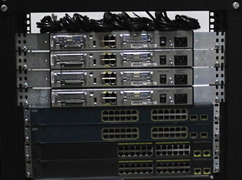
The ideal lab will be using a Cisco UC520 with one FXs, and one FXO and at least 2 IP phones , and some others analog phone, and using you PSTN line at home.

But that will be somehow too expensive, this lab won’t be cheap no matter how you set it.

After reading the book CCNA Voice from Cisco press and watching the CBT Nuggets from the same author Jeremy my home lab was assembled like this.

Cisco 2801 plain (no bundles), no PVDM (DSP), no AIM-CUE installed the price was around $ 800.00 in a prety good condition it had the IOS with them CME installed with it ( ebay ), you could get it cheaper.

Cisco 2620XM ( to communicate with the 2801 with a SIP trunk ) I like this because this one will use the VIC-2FXS and VIC-2FXO which are needed for the analog communication and they are cheaper then the VIC2-2FXS with are used in the 2801. I pay $ 100.00 for it and came with the CME installed with an old version ( 3.2 ). About $30 box for each for each Vic and $65 for the Network Module that will support the VICs, and it will have the DSP need this for this VIC.

My old Catalyst 2950 from my previous CCNA lab did the job on connecting my IP phones I pay like $50.00 ( yes ebay again ). Note that if you have this Switch you won’t get POE which it can turn expensive to get switches with POE included. My solution was to get 4 Power adapters for $10 each one they came from Hong Kong I realized this after ordering them, took 15 days to arrive keep an eye on that.

I used and old analog phone and my analog fax to connect to the 2620XM and reach the CISCO 2801 with the IP phones through a SIP Trunk.

You can get crazy trying to get the VIC2, VWIC2, and the CUE for the 2801, but based on my experience you won’t need them if you read all the information that is provided in the book, in the CBT and look more information by you own you should be good to go.

# 03 Abdul Quddoos

I appreciate you for the answer. I hope thats the best option to go for. Anyway whats about the IP Phones; they can be any or any specific?

# 04 Edwin Matos

Oops,  I forgot my phone description of my home lab.

You will need at least one IP Phone this way you get the real feeling. 7961 Give you 6 Lines, 7941 Give 2 Lines more than enough for your lab, 7902 no display and two lines. My eBay deal went like this (1)7941 $54.00 new, (1)7961 new for $95.00, (1)7961 $60.00 used, (1)7902 $21.00 used.

I went a bit crazy with phones, but two 7941 should do the work for this lab + an analog phone.

Cisco CCNA Training – Some Thoughts 2009

Should you be interested in training in Cisco, it’s most likely that the CCNA is what you’ll need. The Cisco training is designed for people who want to learn about routers and switches. Routers hook up networks of computers to other sets of computer networks over the internet or dedicated lines.

Routers connect to networks, so find a course that features the basics on networks (maybe the CompTIA Network+, possibly with A+ as well) and then do a CCNA course. You’ll need this background understanding on networks before getting going with Cisco or you may encounter problems. When you’ve qualified and are on the job market, you’ll benefit from having a good knowledge of networks to complement your CCNA.

The CCNA qualification is where you need to be aiming – you’re not ready for your CCNP for now. Once you’ve got a few years experience behind you, you can decide if you need to train up to this level. If it is, you’ll be much more capable to succeed at that stage – because you’ll have so much more experience.

Understanding the most fitting job option is very difficult – so which areas should we be checking out and which questions should we be posing?

A ridiculously large number of organisations are all about the certification, and avoid focusing on what you actually need – which is of course employment. You should always begin with the end in mind – don’t get hung-up on the training vehicle. It’s unfortunate, but a large percentage of students commence training that sounds spectacular from the sales literature, but which provides the end-result of a job that is of no interest at all. Try talking to typical university leavers for a real eye-opener.

It’s a good idea to understand the exact expectations industry will have. What particular certifications you’ll be required to have and how you’ll go about getting some commercial experience. Spend some time thinking about how far you think you’ll want to progress your career as it may affect your choice of qualifications. Always seek guidance and advice from an industry professional, even if you have to pay a small fee – it’s considerably cheaper and safer to discover early on if you’ve chosen correctly, instead of finding out following two years of study that you aren’t going to enjoy the job you’ve chosen and have wasted years of effort.

Make sure that all your exams are current and what employers are looking for – forget programs which end up with a useless in-house certificate or plaque. Only fully recognised examinations from the top companies like Microsoft, Cisco, Adobe and CompTIA will mean anything to employers.

People attracted to this sort of work often have a very practical outlook on work, and won’t enjoy sitting at a desk in class, and slogging through piles of books. If this is putting you off studying, go for more modern interactive training, with on-screen demonstrations and labs. If we’re able to involve all our senses in the learning process, then we normally see dramatically better results.

Interactive full motion video involving demonstration and virtual lab’s will beat books every time. And you’ll find them fun and interesting. It’s wise to view some examples of the kind of training materials you’ll be using before you sign on the dotted line. Always insist on video tutorials, instructor demo’s and a variety of audio-visual and interactive sections.

It’s unwise to go for purely on-line training. Connection quality and reliability varies hugely across most broadband providers, make sure you get CD or DVD ROM based materials.

Many training companies only give support to you inside of office hours (typically 9am-6pm) and sometimes a little earlier or later; most won’t answer after 8-9pm at the latest and frequently never at the weekends. Beware of institutions that use ‘out-of-hours’ call-centres – with the call-back coming in during normal office hours. It’s not a lot of help when you’ve got study issues and need help now.

The very best training providers incorporate three or four individual support centres across multiple time-zones. Online access provides the interactive interface to link them all seamlessly, irrespective of the time you login, help is just seconds away, without any problems or delays. Don’t under any circumstances take less than this. 24×7 support is the only viable option when it comes to technical learning. Maybe burning the midnight-oil is not your thing; usually though, we’re out at work at the time when most support is available.

Consider the following facts carefully if you think the marketing blurb about an ‘Exam Guarantee’ sounds great value:

These days, we tend to be a tad more knowledgeable about sales gimmicks – and generally we grasp that we’re actually paying for it (it isn’t free or out of the goodness of their hearts!) It’s everybody’s ambition to qualify on the first attempt. Taking your exams progressively one at a time and paying as you go sees you much better placed to get through first time – you put the effort in and are aware of the costs involved.

Don’t pay up-front, but seek out the best deal for you at the time, and keep hold of your own money. You’ll then be able to select where you sit the exam – so you can find somewhere local. A lot of extra profit is netted by a significant number of organisations who incorporate exam fees into the cost of the course. For various reasons, many students don’t take their exams and so they pocket the rest. Astoundingly enough, providers exist that depend on students not taking their exams – and that’s how they increase their profits. Pay heed to the fact that, in the majority of cases of ‘exam guarantees’ – you are not in control of when you can do your re-takes. You’ll have to prove conclusively that you can pass before they’ll pay for another exam.

The cost of exams was approximately 112 pounds in the last 12 months via UK VUE or Prometric centres. So why pay hundreds or thousands of pounds extra for ‘Exam Guarantees’, when it’s no secret that the most successful method is a regular, committed, study programme, with an accredited exam preparation system.

Sometimes people are under the impression that the tech college or university track is still the most effective. Why then is commercial certification slowly and steadily replacing it? The IT sector now acknowledges that for mastery of skill sets for commercial use, the right accreditation supplied for example by Microsoft, CISCO, Adobe and CompTIA most often has much more specialised relevance – and a fraction of the cost and time. In essence, the learning just focuses on what’s actually required. Actually, it’s not quite as pared down as that, but the principle remains that students need to concentrate on the fundamentally important skill-sets (including a degree of required background) – without attempting to cover a bit about every other area (as degree courses are known to do).

When it comes down to the nitty-gritty: Authorised IT qualifications let employers know exactly what you’re capable of – everything they need to know is in the title: i.e. I am a ‘Microsoft Certified Professional’ in ‘Managing and Maintaining Windows Server 2003′. Consequently an employer can look at their needs and which qualifications are required to fulfil that.

Being at the forefront of progressive developments in new technology gives you the best job satisfaction ever. You personally play your part in defining the world to come. We’re in the very early stages of beginning to scrape the surface of how technology will influence everything we do. Computers and the web will massively revolutionise how we regard and interrelate with the entire world over the years to come.

Should lifestyle be high on your list of priorities, you will be happy to know that the income on average of the majority of IT staff is a lot greater than with most other jobs or industries. It seems there’s no end in sight for IT industry increases throughout this country. The industry is still growing quickly, and we don’t have anywhere near enough qualified skilled IT professionals to fill current job vacancies, so it’s highly unlikely that things will be any different for a good while yet.

About the Author:
The author: Jason Kendall has worked in IT for 2 Decades. He now consults around commercial certification. If you’re interested in CCNA Certification, visit LearningLolly CCNA Training.

CCNA Certification Kit: Exam 640-802

The new edition to the certification kit that features a trio of bestselling CCNA study guides This updated and enhanced certification kit contains CCNA: Cisco Certified Network Associate Study Guide, Sixth Edition; CCNA Fast Pass, Third Edition; and CCNA Virtual Lab, Titanium Edition 2.0. CCNA: Cisco Certified Network Associate Study Guide, Sixth Edition offers in-depth coverage of every exam objective, plus contains updates that reflect new technology developments and key topics that are featured on the exam. CCNA Fast Pass, Third Edition serves as a focused, concise review guide that consists of high-level chapters that map out the main domains of the exam skill-set. CCNA Virtual Lab, Titanium Edition 2.0 is a virtual network simulator complete with hands-on examples and valuable lab exercises allow readers to create a simulated lab using an unlimited number of routers and switches.

Editorial Reviews From Amazon.com

One purchase. Expert training on limited hands-on experience. A near-guaranteed pass. Does it get any better? Not really.

Like your peanut butter in my chocolate, the combination of Sybex’s bestselling CCNA Study Guide and the e-trainer network-simulation software mesh wonderfully. In fact, if truth be told, they always were intended to be sold as one unit; the book contains a lot of rote exercises that is a jumble of instructions if you’re not sitting at a terminal, and the CD comes with practically no instructions at all. Put together in the CCNA Certification Kit, however, they create a force to be reckoned with.

But first, let’s list for you what’s in this little bundle of joy. The CCNA Study Guide is a densely written but comprehensive tome; the writing can be intimidating at times, but Lammle is to be commended for trying to show the reader the reasons that certain networking topics work, instead of merely providing you with lists of items to memorize. The concepts become particularly daunting during the chapters involving TCP/IP subnetting and VLAN trunking–but meticulous rereading will reward you not only with exam-passing knowledge, but with a deep understanding that will serve you well in the corporate world. There are only two slight disappointments: one is the chapter on WAN networking, which is a trifle light compared to the fact-packed density of the rest of the book; the other is that this book is not for absolute beginners, as it skips very quickly over such essential concepts as Ethernet networking and cabling types.

There is a third flaw here–fortunately, it’s nonexistent in this bundle. A large portion of the Guide consists of simple exercises to be run on Cisco routers–which normally is a problem for the CCNA student. Most people don’t have access to, and cannot afford, the roughly $2,500 in equipment that it takes to set up a sample lab. But that’s where the CCNA Virtual Lab e-trainer comes in; it’s a software package that emulates a network that consists of three Cisco routers, a Catalyst 1900 switch, and a couple of WAN links.

For what it does at the price, it does it well. It’s not, by any means, a full-fledged simulation, but it does emulate most of the basic commands well enough for you to pass–and the amount of learning you’ll get from the “hands-on” experience is exponentially better than any amount of book learning. Tinkering around with your own setup will help you remember the oft-cryptic Cisco commands and password levels better than anything else, and the exercises given to you in the study guide will suddenly become full-fledged workshops that expand your learning.

Now, there are those who have criticized the Virtual Lab for many, sometimes valid, reasons: not all the basic commands are adequately supported, the interface is clunky, there are known bugs, and it’s useless beyond anything but the CCNA level. (If you go on to the next level of the Cisco exams, most of the advanced commands aren’t supported.) But there is a saying in the industry that should be well taken here: “Close enough for horseshoes and hand grenades.” Yes, there are better Cisco simulator programs. Yes, there are cheaper ones. No other offering, however, has the range of features and depth that you’ll find at this price–more importantly, it’s enough to pass. Must you have perfection when you can have a passing grade?

In short, the strengths of each item in this boxed set shore up the weaknesses of the other–and, as such, it’s a vital tool in the arsenal of any CCNA aspirant. Highly recommended. –William Steinmetz –This text refers to an out of print or unavailable edition of this title.

You can buy CCNA Certification Kit On Amazon.com

A Question About CCNA Career

#01 smirk

I have a question u might think its a stupid but its always bothering me am planning to do ccna exam soon am from london but where ever u try for a job they ask you for a experience i dont know where to start and what is the best job u should look for after u do ur CCNA ?

#02 Travis Newshott

Experience in IT at all is excellent – many people start with desktop support or pulling cables/rack&stack for network gear. I’ve done time in the “trenches” supporting desktops and while it isn’t fun, it teaches you a lot of troubleshooting fundamentals, lots of processes and down the line when you’re the senior network guy, you better know what questions to ask the desktop guy when they’re reporting a problem!!

A certification alone won’t get you a job – it’s just a piece of paper saying Cisco thinks you’re at a certain level with your technical knowledge. Getting the job is up to you! Best of luck finding a break, sounds like you’re eager to get into some routers!

#03 smirk

Thankyou for your reply and yeah i would love to get into routers job and desktop help job also ask for experience but i dont know where to start u cannot get a experience from a mothers womb unless they giv u a job where can u get ur experience from its hard anyway hope everything goes well thanx.

#04 Travis Newshott

You can also look into apprenticeships or internships – offer your services for lower cost/free to non-profits or the like – somewhere where help is always welcomed. You can also check college IT desktop support or a place where learning is centric to the environment – they are often very forgiving on the learning curve – moreso than a fast paced corporate environment where results are tantamount.

#05 Andrew

You may look into the Cisco Learning Network Job Portal for possible career opportunities.

#06 Wong Teck Wu

The Job portal is a great addition to the site, hopefully it will cover other countries in the future. There’s no results for Singapore, so I guess I’ll stick to my local job portals for now.

#07 Paul Stewart

That is a rhetorical situation isn’t it. Trying to find a job without experience and trying to get experience without a job. You have to break the cycle. Others have and you will too. Unfortunately, we have to be flexible in our approach when new to a field or area of interest. Take opportunities as they present themselves. Also, document what you do to some degree. That will help you quantify on a go forward basis as you find more appealing opportunities.

8 Great Ways to Prepare for the Cisco CCNA 640-802

With so many different textbooks, study guides, cram sheets, and other exam prep material out there, many CCNA candidates become fixated on only one or two study methods. While there are comprehensive, one-stop study tools available, the best prepared candidates will look to use multiple forms of media and practice to ace the 640-802 examination. Here’s a look at some of the ways you can prepare for the CCNA 640-802 exam:

  1. CCNA 640-802 Simulators: Hands-on training and practice are great ways to prepare for the 640-802 Cisco CCNA exam, but Cisco routers and other equipment are expensive and usually out of budget for most candidates. Simulation products allow candidates to practice working with Cisco equipment by simulating only the components of IOS that appear on the examination. Plus, simulators are way cheaper (typically in the $30 – $60 range) and have been proven as an effective means to study for the CCNA.
  2. Practice Tests: You wouldn’t jump into the deep end of the pool without making sure you can swim in the shallow end, so why risk taking the 640-802 before taking a few practice tests? Take a look at SemSim CCNA  exam simulation software or search for the many other practice tests available on the Internet and avoid the risk of cold feet on exam day.
  3. Flashcards: This isn’t grade school, but it sure seems close – still, old-fashioned flashcards or similar memory tools will help you retain the key facts and details on the exam. Handwritten flashcards are great for studying on the go or with a small block of free time. Flashcards are also freely available online and can prove to be an extremely efficient way of quick study on your PC. Either way, this old-school method of study can provide great results.
  4. DIY: The best study guides are often the ones you create on your own. When you write your own study guide, you can focus on the points that are unclear or difficult for you while skimming over information that you already know very well. Of course, writing your own guide is not the only way you should be preparing for the 640-802, but combined with traditional study methods, doing it yourself can be highly rewarding.
  5. Cisco CCNA 640-802 Exam Objectives: The exam objectives are by no means detailed, but they are comprehensive. The nice thing about studying for the exam based on the objectives is that you know that you are covering exactly what is on the test – nothing more, and nothing less. The downside, of course, is that you will have to find the information on your own. Try this in conjunction with writing your own guide and you’ll have a winner.
  6. Forums: Message boards and other online communities will often have valuable, insider tips on the exam that you really can’t find anywhere else. More importantly, they give you a chance to access and communicate with other test takers who may have valuable experience to share.
  7. Back to the Basics: This means reading up on networking basics and even reviewing study materials for other, easier networking exams such as the CompTIA Network+ examination. It’s the opposite of studying exam objectives but reviewing networking fundamentals can really help you on all facets of the 640-802 as it is a networking exam. So, go ahead and review your TCP/IP, NAT, DHCP, and your other favorite networking initials.
  8. Study Guides: We know how valuable study guides are, so why list them last? The truth is that while study guides can be great ways to learn all of the facts you need for the exam, they range widely in depth and comprehensiveness. In other words, one size does not fit all. We recommend that you use at least one study guide in your preparation for the CCNA 640-802, but please make sure you take a look at the other seven options above along with practice from an effective study guide.

Next Page »